On Computable Numbers, with an Application to the Entscheidungsproblem
The paper that defined what "to compute" means, proved that no algorithm can decide all mathematical truths, and in doing so invented the abstract machine every CPU, container, and inference server descends from.
What · How · Why
What it is
Turing asks a deceptively simple question — what does it actually mean to "compute" something? — and answers it by inventing an abstract machine simple enough to reason about yet powerful enough to capture any mechanical procedure. Along the way he proves that some precisely-stated problems can never be solved by any machine, settling Hilbert's question of whether mathematics is fully decidable (it is not).
How it works
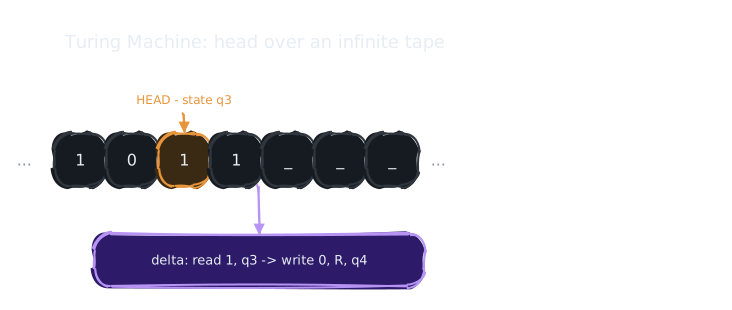
He models computation as a head moving over an infinite tape, reading and writing symbols according to a finite table of rules — that table is the program. He then shows a single "Universal" machine can read another machine's description from the tape and imitate it, which is the principle that code and data are the same stuff. Finally he uses a self-referential trick (feed a machine its own description) to derive a contradiction, proving no machine can decide in general whether an arbitrary program halts.
Why it matters
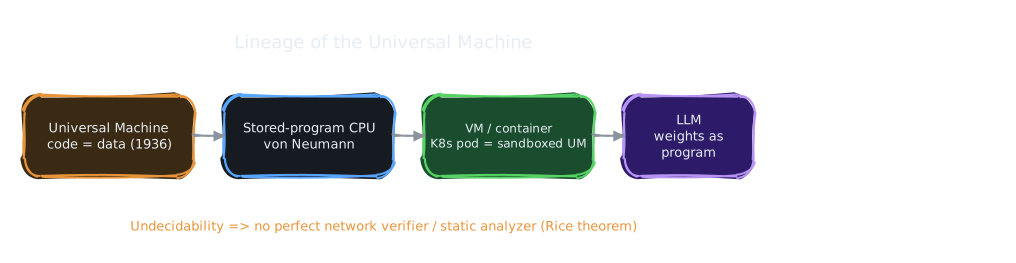
This is the root of computing: every CPU, container, Kubernetes pod, and LLM is a Universal Machine in disguise, all descending from the 1936 code-is-data insight. The undecidability result is not academic — it is exactly why you cannot build a perfect verifier for arbitrary network configs or a guaranteed-terminating AI agent loop, forcing real tools into restricted, decidable fragments.
Round 1 — Core Claim & Mental Model
The problem it solves
Hilbert's Entscheidungsproblem (1928) asked: is there a definite mechanical procedure that, given any first-order logical statement, decides whether it is provable? To answer "no," Turing first had to make "mechanical procedure" mathematically precise — there was no prior formal definition of algorithm. The deep move is that the negative answer is a by-product; the lasting contribution is the definition.
Mental model
Imagine a clerk with an infinite paper tape divided into cells, a pencil/eraser, and a tiny rulebook. The clerk sees one cell, holds one "state of mind," and the rulebook says: given (symbol I see, state I'm in) → write a symbol, move one cell left/right, switch state. That is the entire machine. Turing's claim: anything a human computer can do by following fixed rules, this clerk can do.
What would be true if the paper is right
There exists a single Universal machine \(U\) that, given a description \(\langle M\rangle\) of any machine plus its input, simulates \(M\). This is the stored-program principle: code is data. If true, general-purpose computers are possible at all — and some precisely-stated problems are provably unsolvable by any machine.
Round 2 — Mathematical Model
Formal definition
A Turing machine is a 7-tuple
\[ M = (Q,\ \Sigma,\ \Gamma,\ \delta,\ q_0,\ q_{\text{acc}},\ q_{\text{rej}}) \]with finite state set \(Q\), input alphabet \(\Sigma\), tape alphabet \(\Gamma\supseteq\Sigma\cup\{\sqcup\}\), start/accept/reject states, and a transition function
\[ \delta:\ Q\times\Gamma \;\to\; Q\times\Gamma\times\{L,R\}. \]Key results
Universality. There is a machine \(U\) such that for all \(M,x\): \(\;U(\langle M\rangle, x) = M(x)\). A finite object can emulate the entire infinite family of machines.
Undecidability of halting. Let \(H=\{\langle M\rangle\,x : M \text{ halts on } x\}\). \(H\) is not decidable.
Derivation sketch (the diagonal argument)
Suppose a decider \(D(\langle M\rangle,x)\) outputs HALT/LOOP correctly. Build
\[ K(\langle M\rangle)=\begin{cases}\text{loop forever} & \text{if } D(\langle M\rangle,\langle M\rangle)=\text{HALT}\\[2pt]\text{halt} & \text{if } D(\langle M\rangle,\langle M\rangle)=\text{LOOP}\end{cases} \]Now run \(K\) on its own description. \(K(\langle K\rangle)\) halts \(\iff\) \(D\) says it loops \(\iff\) it does not halt. Contradiction, so \(D\) cannot exist. This is Cantor's diagonalization transplanted onto programs.
Complexity / cost
This is a computability result, not complexity — it ignores time. But it sets the ceiling: no resource budget rescues an undecidable problem. The price of universality is that \(U\) incurs only a constant-factor / polynomial slowdown simulating \(M\), which is why "real computers ≈ Turing machines" holds for what is computable, even if not for how fast.
Invariants
Church–Turing thesis: the class of effectively computable functions is invariant across models — λ-calculus, μ-recursive functions, RAM machines, and modern ISAs all compute exactly the same set. This invariance is the reason the model still describes 2026 hardware.
Limiting cases
Finite tape ⇒ a finite automaton (strictly weaker — cannot match parentheses unboundedly). Remove the diagonal trick (e.g. restrict to total functions / primitive recursion) ⇒ everything becomes decidable but you lose universality. There is no free lunch: universality and total-decidability are mutually exclusive.
How It Works & Visual Diagrams
Mathematical Proofs
Turing's two pillars are a positive result (a single machine simulates all others) and a negative one (some questions about machines are unanswerable by any machine). The negative result is a self-reference / diagonal argument — the same engine behind Cantor and Gödel.
- If \(D\) halts on \(\langle D\rangle\), then by definition of \(h\), \(h(\langle D\rangle,\langle D\rangle)=1\); but then \(D\) was built to loop — contradiction.
- If \(D\) loops on \(\langle D\rangle\), then \(h(\langle D\rangle,\langle D\rangle)=0\); but then \(D\) was built to halt — contradiction.
Why this matters downstream: undecidability is a hard ceiling on tooling. No general verifier can certify that an arbitrary config script terminates, or that a generated program is correct — see the verification caveat carried into GPT-3, and the universal-computation lineage into the Transformer.
Round 3 — Limitations & Community Response
What it does not give you. The model is silent on cost. Decidable ≠ feasible: SAT is decidable but NP-complete. The genuinely interesting modern questions (P vs NP, fine-grained complexity) live entirely above Turing's layer.
Physical idealization. Infinite tape and noiseless steps are fictions. Real machines are finite-state; the Turing model's relevance is asymptotic. Hypercomputation proposals (oracle machines, relativistic/analog computers) periodically claim to exceed it — none has a physically realizable construction, and the Church–Turing thesis remains unbroken.
Community arc. Church's λ-calculus (1936) reached the same conclusion independently and slightly earlier; Gödel reportedly accepted the informal notion of computability only after seeing Turing's machine formulation — its mechanical concreteness is why Turing's version, not Church's, became the standard mental model. Rice's theorem (1953) later generalized undecidability: every non-trivial semantic property of programs is undecidable.
Round 4 — AI × Networks Connection
This node is the root of the entire KB; nearly everything downstream is a Universal Machine wearing a costume.
Networks angle. Rice's theorem is why you cannot build a static analyzer that decides whether an arbitrary network configuration (firewall ruleset, BGP policy, P4 program) is "correct" in general. Practical tools (verification, intent-based networking) escape the wall only by restricting the language to a decidable fragment — exactly Round 2's "lose universality to gain decidability" trade.
AI angle. A Transformer with chain-of-thought / external memory is Turing-complete; the question "will this agent's loop terminate?" is the halting problem in disguise — hence no general guarantee of agent termination. LLM weights are a program shipped as data: the 1936 code-is-data insight, monetized.
Verify — Credibility Check
The proofs are constructive and self-contained; "credibility" here is logical, not empirical. The argument has survived 90 years of scrutiny and was formally re-verified in proof assistants (Coq, Isabelle). One historical footnote worth knowing: Turing's original paper contained minor bugs in the universal-machine construction, corrected in a 1937 addendum — the result was never in doubt, only the bookkeeping. Single experiment that would "break" it: a physically-realizable device deciding the halting problem. None exists; the claim is as settled as mathematics gets.
- Where exactly is the decidable/undecidable boundary for real network-config languages — and can intent-based networking be pinned to a provably-decidable fragment without losing expressiveness operators actually use?
- If LLM-agent loops are Turing-complete, what restricted "agent calculus" gives termination guarantees while keeping useful autonomy?
- Does the constant/polynomial slowdown of universality matter for edge inference, where the gap between "computable" and "computable within the latency budget" is the whole game?